Welcome to WordPress. This is your first post. Edit or delete it, then start writing!
Blog
-
Beyond the Mask of Impostor Syndrome
“I am just lucky.” “It is only a matter of time before they realize I do not belong here.” “I am a fraud.”
If these thoughts sound familiar, you are navigating a silent epidemic among high achievers. Despite a track record of tangible results and earned qualifications, many professionals live in a state of “waiting to be found out.” This is not merely a lack of confidence, it is a psychological pattern known as Impostor Syndrome: a feeling that your success is not truly yours.
The 62% Reality: A Systemic Issue
It is easy to believe that you are the only one in the room feeling this way, but the data suggests otherwise. Research indicates that approximately 62% of professionals experience features of the impostor phenomenon at some point in their careers (Workplace Insight).
This is not a reflection of your actual ability, but often a reflection of the environment you work in. A study from Vrije Universiteit Amsterdam highlights how competitive work cultures act as fuel for these feelings. When a system prioritizes perfection and constant comparison, the mind struggles to internalize its own achievements. We begin to credit “luck” or “timing” for our wins, while viewing our mistakes as proof of our incompetence.
The Irony of the High Achiever
One of the most important facts to understand about Impostor Syndrome is that it rarely affects those who are indifferent. It typically targets individuals who have high standards, a desire for growth, and a deep commitment to their craft (PubMed 2020).
The “inner critic” that tells you that you aren’t enough is often the shadow side of your ambition. It is a sign that you care deeply about your work. However, when left unchecked, this mindset leads to chronic stress and a significant decrease in job satisfaction. It creates a friction where you are constantly running, not to move forward, but to avoid being “caught.”
Journaling Your Way to Ownership
The first step to dismantling the impostor mindset is to move these feelings from your head onto paper. By documenting your thoughts, you can begin to separate objective facts from subjective fears. Take 10 minutes to sit with your journal and explore these questions:
-
In which specific situations does my inner critic get the loudest? (e.g., during meetings, when receiving praise, or when starting a new project).
-
If I had to list three things I achieved this year that had nothing to do with “luck,” what would they be?
-
Why do I find it difficult to claim my successes as my own? What am I afraid would happen if I truly believed I was capable?
Mindset Exercises: Mapping Your Strengths
Healing from Impostor Syndrome requires a conscious shift in perspective. It involves learning to look at yourself with the same realism and kindness you would offer a peer.
Start a “Success Log” in your journal. Map out your qualities and reflect on what you have achieved—not as a matter of chance, but as a result of your specific efforts and skills. Small, consistent steps in self-recognition help to quiet the inner critic. You are not a fraud; you are a work in progress, and you have already earned your seat at the table. Be as gentle with yourself as you are ambitious.
Sources
-
PubMed. (2020). Global prevalence of imposter syndrome in health service providers: a systematic review and meta-analysis.
-
Vrije Universiteit Amsterdam. (2023). Competitive work culture fuels impostor feelings.
-
Workplace Insight. (2023). Nearly two thirds of Europe’s workers say they experience Impostor Syndrome.
Sources
-
Ancient Origins. (2018). The Ancient Origins of New Year’s Celebrations. https://www.ancient-origins.net/myths-legends/ancient-origins-new-years-celebrations-001181
-
Britannica. (n.d.). Why Does the New Year Start on January 1? https://www.britannica.com/story/why-does-the-new-year-start-on-january-1
-
Marie Claire. (2023). Feeling Fatigued? How to Avoid the Dreaded Winter Slump, Now the Clocks Have Gone Back. https://www.marieclaire.co.uk/life/health-fitness/how-to-avoid-winter-slump?
-
NU.nl. (2021). Geen concentratie? Slechte slaper? Misschien moet je wat meer daglicht zien. https://www.nu.nl/werk/6097007/geen-concentratie-slechte-slaper-misschien-moet-je-wat-meer-daglicht-zien.html?
-
PubMed. (2017). The impact of daytime light exposures on sleep and mood in office workers. https://pubmed.ncbi.nlm.nih.gov/28535410/
-
Rutgers University. (n.d.). How Did April Fools’ Day Get Started? https://www.rutgers.edu/news/how-did-april-fools-day-get-started

-
-
Why You Should Stop Fighting Winter Blues
There is a more heavy pull during winter: a desire to stay under the covers a little longer, a haze over the usually sharp focus of our ambitions. In our modern, high-output society, we have been pushed to view a drop in productivity as a personal failure. We treat our minds like machines that should function with the same efficiency regardless of the season.
However, as we move through February, your body is simply trying to tell you that you are a biological being, not a programmed device. You are not “lazy”, you are simply in sync with a world that is more asleep.
The Systemic Mismatch: The Artificial New Year
In December, we often reflect on the year and set resolutions for the next. While this intention-setting is valuable, setting goals for the winter as demanding as for the summer, often results in disappointment. When spring finally arrives, we frequently find we haven’t accomplished what we intended.
Historically, the human “start” was never meant to be in the frost. For centuries the New Year was naturally tied to the Vernal Equinox (Ancient Origins 2018). Whether it was the Ancient Babylonians or the Phoenicians, the beginning of the year followed the rhythm of the Earth, signaling a return of light and the true start of the agricultural cycle in late March.
Even the playful traditions of our modern era carry the echoes of this history. The shift from a Spring-based New Year to a January start was a result of legal and religious shifts in the 16th century (Rutgers University). That’s where “April Fools” comes from, mocking those who continued to celebrate the New Year in the spring (after the calendar was officially changed). By April many of us are now already exhausted, feeling like failures because we haven’t achieved all the goals we set. But the truth is, you were never meant to bloom in the frost.
The Biology of Retreat
The New Year biologically starts in April, when it gets warmer and nature comes to life again; that is the true new beginning. The Chinese celebrate the new year with the Spring Festival, it’s based on based on a lunisolar calendar rather than the solar Gregorian calendar. Multiple countries like Thailand, Cambodia, Iran, Turkmenistan, and Ethiopia celebrate the new year in (their) spring. The western calendar is not something we can change (back) overnight, but it is essential to understand that there is nothing wrong with you. It is our system and society that is doing us injustice.
In nature, winter is not a season of doing; it is a season of being. Trees pull their sap inward to protect their core. Animals hibernate or significantly slow their metabolic rates to survive the cold. They don’t apologize for this lack of “output”, it is their strategy for survival and future growth. Humans are part of this ecosystem, yet we are the only species that tries to ignore the seasons.
Research confirms that our biology is deeply tied to the light. Studies show that reduced (daytime) light exposure directly impacts our sleep-wake cycles and mood (PubMed 2017). When we don’t get enough natural light, our bodies produce more melatonin (making us sleepy) and less serotonin (the “feel-good” hormone). Thus when the sun is scarce, our bodies naturally want to retreat. Marie Claire discusses how this “winter slump” is a physical response to our environment. By forcing “summer energy” in February, we create a friction that leads to burnout. When we feel this way, our instinct is to “push through.” But you cannot out-hustle your biology.
Journaling Your Way to Clarity
The first step to feeling better isn’t caffeine or a tighter schedule, it is acceptance. To help you lean into this seasonal rhythm, take your journal and answer these questions:
-
Where am I losing the most energy right now? Is it a specific task, a habit, or a lack of boundaries between work and rest?
-
Where am I currently forcing myself to perform at a level that doesn’t feel natural?
-
What I am longing for more during these darker months? (warmer drinks, softer lighting, more frequent breaks, short walks).
Trusting the Cycle
Acceptance is not about giving up, it’s about removing the judgment. When you stop being hard on yourself for having lower energy, you stop wasting your limited reserves on self-criticism. While we can make small adjustments to find more light, the most significant shift happens internally when we stop fighting our own nature (NU.nl 2021).
The harvest only happens because the soil rested in the winter. Your current “slowness” is not a lack of progress, it is the preparation for your next season of growth. February is for nesting, dreaming, and strengthening your roots beneath the surface. It’s the permission to go to bed an hour earlier or to keep your to-do list a little shorter this week. Be gentle with yourself.
Sources
-
Ancient Origins. (2018). The Ancient Origins of New Year’s Celebrations. https://www.ancient-origins.net/myths-legends/ancient-origins-new-years-celebrations-001181
-
Britannica. (n.d.). Why Does the New Year Start on January 1? https://www.britannica.com/story/why-does-the-new-year-start-on-january-1
-
Marie Claire. (2023). Feeling Fatigued? How to Avoid the Dreaded Winter Slump, Now the Clocks Have Gone Back. https://www.marieclaire.co.uk/life/health-fitness/how-to-avoid-winter-slump?
-
NU.nl. (2021). Geen concentratie? Slechte slaper? Misschien moet je wat meer daglicht zien. https://www.nu.nl/werk/6097007/geen-concentratie-slechte-slaper-misschien-moet-je-wat-meer-daglicht-zien.html?
-
PubMed. (2017). The impact of daytime light exposures on sleep and mood in office workers. https://pubmed.ncbi.nlm.nih.gov/28535410/
-
Rutgers University. (n.d.). How Did April Fools’ Day Get Started? https://www.rutgers.edu/news/how-did-april-fools-day-get-started

-
-
How to get the most out of your journal
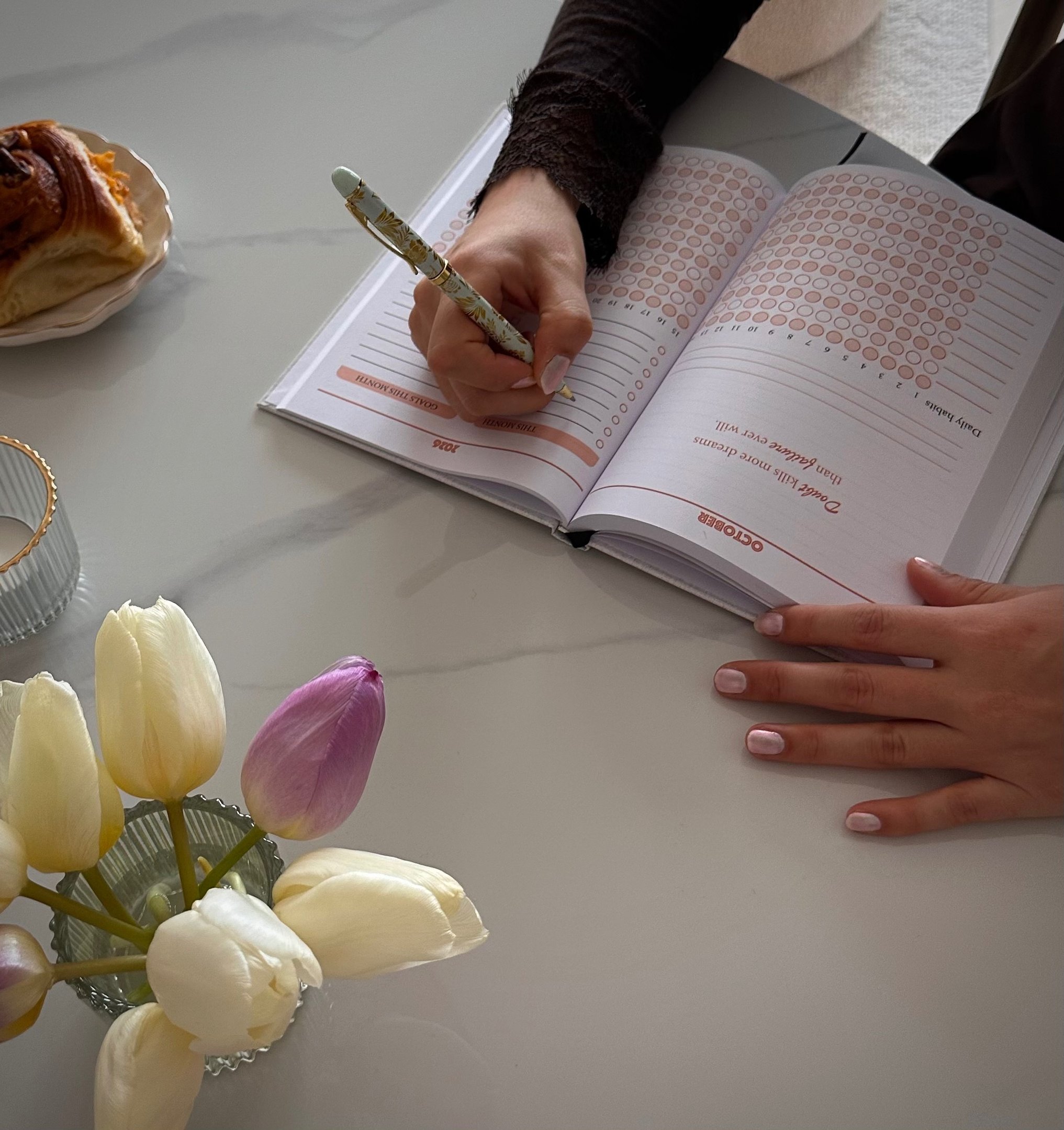
You can use the Peb Talks journal as a planner, habit tracker, notebook, as dream diary or however it fits you!
Daily reflection questions
-
What am I looking forward today?
-
What is one thing that would make today great?
-
How can I start my day off on a positive note?
-
Three things I am grateful for
-
What made me proud today?
-
What made me feel content or thankful?
Write down your tasks, meetings, dinners, events
Add a symbol afterwards:
– Drained my energy
+ Gave me energy
++ Gave me a lot of energy
This helps you understand what fuels or drains you
Getting to know yourself better
-
When do I get negative & positive thoughts?
-
What triggers me, makes me lose (emotional) control?
-
When do I feel overwhelmed, and what usually causes it?
-
What made me feel calm or safe?
-
What makes me SMILE no matter what?
Every month start with a quote.
Underneath you can write a quote yourself, a lesson you learned, a mantra, or an intention for this month.
Here are some examples:
… this month
-
Birthdays
-
Deadlines
-
Trips
-
Events
-
Selfcare
Habits to track
-
Wake-up time
-
Mindfullness/ meditation
-
Movement or exercise
-
Happiness level
-
Energy/ motivation level
-
Glasses of water
-
Time outside
-
Time reading
-
Bed time
-
Sleep grade
Track what matters to you!

-